
KEPLERS LITERARY FOUNDATION
Saturday, August 19, 2023

Praise for Unmarriageable
Libraries:
Global Book Read Pick Fairfax County Library
Brooklyn Public Library Read/Pick
New York Public Library a Summer 2019 Pick
Arlington Public Library VA Book Club Read/Pick
Fleming Island Library FL Book Club Read/Pick
WA North Olympic Library System ‘An Off the Shelf Pick’
Recommendation “Finding Love at the Library”
Westlake Village Library LA Book Club Read/Pick
Cheshire Public Library CT Recommendation
West Allis Public Library Staff Reads “rejoice! Here is a page turner of a retelling”
Lake Agassiz Library MN Summer Read
Recommendation “quick, witty, and clever story for a summer afternoon read.’
Sharon Forks Library GA Read/Presentation
Gwinnett Public Library GA Read and Presentation
Northeast Spruill Oaks Library GA Read and Presentation
Roswell Library GA Book Club Read/Pick
OWLS LITTLE LIBRARY Top Ten Audio Book2019
Penguin Random House’s 2020 Book Your Summer Reads
ASIAN IMAGE: “This sumptuous book is so refreshingly relatable to young Asian women today … A compelling story about marriage, class and sisterhood”
JANE AUSTEN BOOKS “Unmarriageable is our favorite Jane Austen Adaptation.”
THECURIOUSREADER.in – “one of the best literary adaptations of Pride and Prejudice”
DAWN, Pakistan’s biggest national newspaper: There is, in Kamal’s novel, notable attention to detail when it comes to situating characters within a specific class context that Anglophone Pakistani fiction rarely manages to accomplish. Unmarrigeable works as an adaptation of Pride and Prejudice because it doesn’t let the romance overtake the social commentary, but also doesn’t allow the social commentary to be too sweeping and obvious. It walks the tightrope of reminding the reader of the best of Austen’s novels while also being an enjoyable narrative in its own right.
— full chapter in French text Book
— highlighted on PBS Books
BUZZFEED A “Feel Good Book That Will Make You Believe in Love”
BOOK RIOT “Fast paced and hilarious.. an engaging romance as well as a serious meditation on the legacy of colonialism”
NEW YORK POST A Best Book of the Week Pick
BOOKISH Must-Read Romance 2019
BUSTLE The Romance You Have to Read
SCROLL.IN Rewriting Jane Austen is an industry. But this version of ‘Pride and Prejudice’ in Pakistan shines… The timeless value of a classic in English is that its importance comes from the language and our aspirational obsession with it. And then Soniah Kamal comes along and subverts it all… a subtle but firm critique on English being a language of power, a tongue that we hold on to viciously because it protects the gates of South Asian social privilege.
HEAT MAGAZINE Unmarriageable is the Funny One
BARNES AND NOBLES Staff Recommendation, Alderwood WA
HELLO GIGGLES A Best New Book of The Week
NPR CODE SWITCH a Summer 2019 Read Pick
ATLANTA JOURNAL CONSTITUTION One of the 10 Southern Books We Want to Read in 2019
RANDOM HOUSE READERS CIRCLE PICK
CULTURE HONEY A brilliant rendering of Austen’s masterpiece
LIVEMINT Kamal, a Pakistani American author, makes the old tale fresh again, with her canny exploration of Pakistani society.
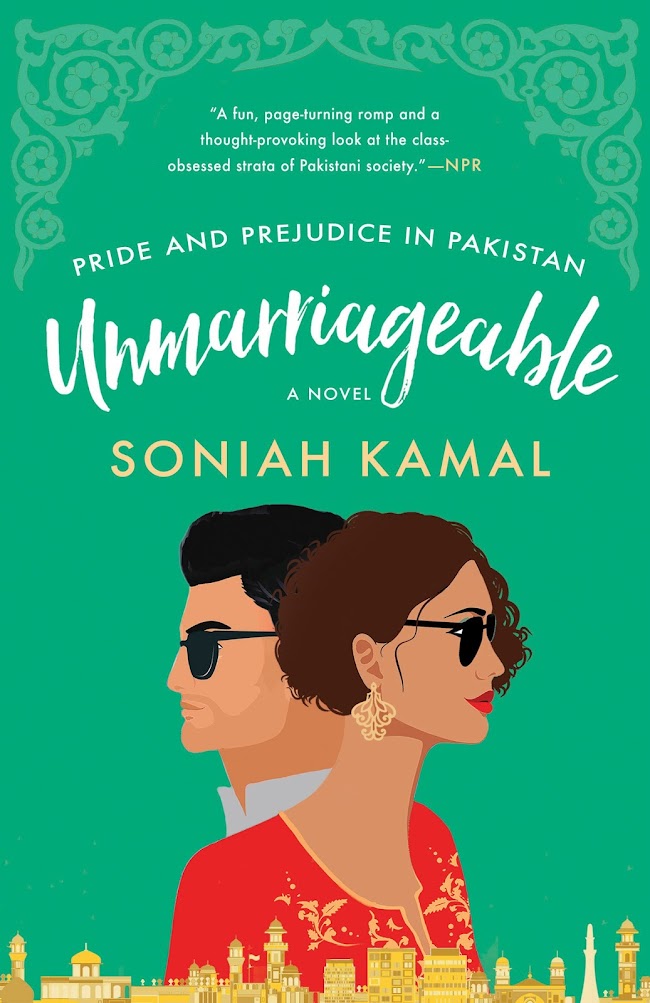
NPR Both a fun, page-turning romp and a thought-provoking look at the class-obsessed strata of Pakistani society
KEPLER’S LITERARY FOUNDATION For Austenites and fans of rich cultural commentary comes the effervescently charming Unmarriageable. More than merely a playful, absolutely captivating and enjoyable retelling of the classic novel, this updated narrative, set in 2001 Lahore, also packs incredible wit and underlying power. Feminist, fun, richly imagined and filled with coded Urdu puns, this is a book you don’t want to miss.
Georgia Author of the Year Literary Fiction nominee 2020
Books All Georgians Should Read 2019
Finalist for Townsend Prize for Fiction 2020
Financial Times Readers Best Book of 2019
PHS Reviewers Choice Awards Finalist 2019
PEOPLE MAGAZINE PICK This reinventive retelling charms
BOOK BUB A Best Book of 2019 so far/ Best New Book Readers Can’t Stop Talking About/Best Read on a Rainy Day
AMAZON BEST BOOK PICK FICTION AND LITERATURE JANUARY 2019
AUDIOFILE Soniah Kamal delivers a passionate and jovial narration
LIBRARY READS A January Top Ten Book Pick Voted by U.S. Librarians 2019
BUSTLE One of the most anticipated reads for 2019
PARADE Recommended Big Fiction Read for Book Clubs
SOUTHERN LIVING a perfect beach read
ACADEMY of CHRISTIAN EDITORS recommended Best Book of the Year 2019
READ IT FORWARD Anticipated Read 2019 & A Favorite January Read
GOODREADS Anticipated Literary Reads for Readers of Color 2019
BOOKBOUND FESTIVAL UK Unmarriageable is the perfect bank holiday read
SHE READS ANTICIPATED READ 2019
PERPETUAL PAGE TURNER ANTICIPATED READ 2019
GOODREADS HOTTEST ROMANCES of 2019
PUBLISHERS WEEKLY BOOKS OF THE WEEK PICK
PEOPLE MAGAZINE This Inventive Retelling Charms
NEW YORK JOURNAL OF BOOKS Insightful…Smart…A witty delight that will leave you wish for more
JASNA-Greater Louisville Unmarriageable has quickly become a beloved favorite of the Jane Austen Society of North America Louisville Chapter
ELLE Delightful retelling of Jane Austen’s classic. You’ll tear through it.
PUBLISHERS WEEKLY
Starred Review
A funny, sometimes romantic, often thought-provoking glimpse into Pakistani culture, one which adroitly illustrates the double standards women face when navigating sex, love, and marriage. This is a must-read for devout Austenites.
LIBRARY JOURNAL
Starred Review
Pride and Prejudice in Pakistan may seem like an unusual pairing to some, but the rich cultural backdrop only enhances and breathes new life into Jane Austen’s classic. Kamal boldly embraces this treasured love story, creating a version solely her own.
SHELF AWARENESS
Starred Review
If Jane Austen lived in modern-day Pakistan, this is the version of Pride and Prejudice she might have written. Unmarriageable by Soniah Kamal is a distinctly entertaining update of Pride and Prejudice. It features all of the memorable plot details of Jane Austen’s masterpiece but is cleverly reworked to reflect the state of modern society in the Muslim country of Pakistan.
NPR As with Austen, whose books could be read as fun and simple romances or acerbic examinations of class and women’s choices (and lack thereof), Kamal’s Unmarriageable succeeds in being both a deliciously readable romantic comedy and a commentary on class in post-colonial, post-partition Pakistan, where the effects of the British Empire still reverberate. . . . Both a fun, page-turning romp and a thought-provoking look at the class-obsessed strata of Pakistani society.”
NEW YORK JOURNAL OF BOOKS “an insightful and smart look at Pakistani culture and the ways in which women are viewed and how they view themselves. . . . shed[s] light on the double standards and limitations that are set upon women . . . It is a witty delight that will leave you wishing for more.”
AUSTENPROSE, editor Laurel Ann Nattress A witty, razor sharp view of Pakistani culture paralleling JAne Austen’s Regency-era, Unmarriageable is the Pride and Prejudice retelling of my dreams.
STAR TRIBUNE Unmarriageable does in words what Gurinder Chadha did in film with “Bride and Prejudice”
INTERNATIONAL EXAMINER This postcolonial rewriting of Austen both pays tribute to the great novelist while also demonstrating how much British colonialism contributed to the cultural reshaping of modern South Asia in general and Pakistan in particular. The novel is a must-read for fans of Austen and the many adaptations of her work.
THECURIOUSREADER.IN a fresh and delightful retelling of this classic novel. Unmarriageable, therefore, is an interrogation into the ways in which our politics are dictated by our social position, class and gender. It explores the impact and influence of the English language when it comes to our understanding of South Asian feminism while boldly attempting to unravel the privilege that gives mileage to the politics of Austen’s most popular protagonist Elizabeth.
KAT IN THE LIBRARY “We can all agree that it is rare for a reboot to rival the original. But in this world, where #MeToo and #
ATLANTA JOURNAL CONSTITUTION Kamal’s resplendent second novel embraces and builds upon its predecessor in such a fresh way that a new class of “P&P” lovers will likely be born
STAR TRIBUNE Delightful . . . Unmarriageable introduces readers to a rich Muslim culture. . . . [Kamal] observes family dramas with a satiric eye and treats readers to sparkling descriptions of a days-long wedding ceremony, with its high-fashion pageantry and higher social stakes.
NRI PULSE Unmarriageable, stewed with Kamal’s insights into culture and class distinctions, race and colonization, and a generous measure of sisterhood, love and marriage, simmers quite a succulent dish. Kamal’s rich references to works in English and Urdu, skillfully incorporated into the narrative, enriches the reading experience.
BOOKBROWSE Told with wry wit and colorful prose, Unmarriageable is a charming update on Jane Austen’s beloved novel and an exhilarating exploration of love, marriage, class, and sisterhood.
WASHINGTON REVIEW Of BOOKS Thoughtful and whip-smart, Unmarriageable reinforces the timelessness of Austen’s classic while spinning a lively, complex story that makes for perfect winter-weekend reading
MODERN MRS DARCY Watch Bridget Jones’s Diary, Read Unmarriageable. Both are fun, funny and worth your time. Especially Love the Cultural Commentary in Unmarriageable.
THE DAILY VOX The perfect Pride and Prejudice retelling
NEW ADULTING “Classic in its literary style, simple in its storytelling, detail-oriented and specific in its ascription of femininity, Kamal’s Unmarriageable brings Austen to those who aren’t fans of older English literature but are hungry for a reimagined canon.”
KIRKUS REVIEWS “Kamal’s version of the classic novel highlights issues of colonialism, race, and Pakistani identity. Her insights are pointed and smart. Put your feet up and enjoy. It’s a delicious book.”
BOOKLIST “This love letter to Austen reexamines sisterhood, society, and marriage in Pakistani culture and includes a fleshed-out epilogue that will satisfy today’s readers.”
NEW YORK POST Thoroughly Charms
BOOK CORNER The rich cultural backdrop of modern-day Pakistan breathes new life into Jane Austen’s “Pride and Prejudice.” An Austen fan herself, Kamal remains faithful to the original story while dazzling readers with a humorous and entertaining update of a beloved classic (meaning this is one you’ll actually love).
A CUP OF TEA WITH THAT BOOK PLEASE Finally an Austen adaptation we can be proud of. Kamal captures the Austen magic that we long for in our Austen retellings. But, even without the Austen characteristic this is one enjoyable read that can stand on its own feet
KHABAR MAGAZINE Unmarriageable is a delightful, searching novel with a postmodern and postcolonial sensibility
NATIONAL.AE Unmarriagable is a retelling set in Pakistan that packs almost the same wit and punch as Austen herself. Austen’s penchant for satire is put to brilliant use in Unmarriagable, not only in situations but also in the naming of her characters
MORNING READER In a sea of Pride and Prejudice retellings, Unmarriageable is my favorite yet. Themes, plot and characters are woven into the setting of modern day Pakistan that it feels as though this is exactly what Austen had hoped for.
LOIS REITZES, host of City Lights, WABE NPR Unmarriageable by Soniah Kanal is exceptionally clever and a great read.
BALLI KAUR JASWAL, author of Erotic Stories for Punjabi Widows “Unmarriageable raises an eyebrow at a society that views marriage as the ultimate prize for women. Crackling with witty dialogue, family tensions, humor, and rich details of life in contemporary Pakistan, it tells an entirely new story about love, luck, and literature.”
VANESSA HUA, author of A River of Stars “Charming and insightful, Soniah Kamal’s Unmarriageable connects the concerns of women across time and cultures in this delightful debut.”
JENNIFER BROWN, author of Modern Girls “Kamal’s Unmarriageable is a witty and clever update on Pride and Prejudice, setting familiar characters in a modern-day Pakistan. While the plot is straight out of Austen, the change of scene and time period makes for a fresh and feminist spin on the story. Even if you’ve memorized the original, the romance between Alys Binat and Valentine Darcy will still sweep you into its magic, and the glimpse into Pakistani culture (and food! Oh the food!) makes this book a delight.”
COLLEEN OAKLEY, author of Before I Go and Close Enough to Touch “It’s rare for a retelling of a well-known story to be so surprising, so delightful, so gripping— but Unmarriageable is undeniably all three. I inhaled this book in two days. Not only is it sharply funny, but it gently reminds us that the issues facing modern women transcend time and culture. I can’t wait to see what Kamal writes next.”
LAUREN GERSHELL, author of That’s What Frenemies Are For “I loved Unmarriageable. A new take on Pride and Prejudice, set in early 2000s Pakistan, I was immediately mesmerized. Kamal’s descriptions are vibrantly rich and charming, and her characters beautifully developed (there are a huge number of characters to keep track of, so this is quite an achievement). I was particularly taken with how funny (in incredibly funny ways) the book was, which was completely unexpected. Unmarriageable was an utter delight to read- the perfect novel for when one wants something fun and light yet literary and smart.”
FALGUNI KOTHARI, author of The Object of Your Affections “The beauty of Unmarriageable is that every character is at once familiar and yet wonderfully brand new in their Pakistani garb. It’s like bumping into long-lost friends at a party and sitting down to catch up, marveling at all the changes the years have wrought and yet delighting in their familiarity”
THRITY UMRIGAR, bestselling author of The Space Between Us “An irreverent, witty, imaginative novel that is part homage and part interrogation of Jane Austen’s classic. Austen herself would have enjoyed Kamal’s deft retelling of her novel, while sipping a cup of chai.”
JENNIFER TARHEEL READER “If you are a Pride and Prejudice fan, don’t miss this one. If you aren’t, don’t miss this one. If you are a fan of diverse, multi-cultural reads, don’t miss this one. Moreover, if you are a fan of impeccable storytelling, Unmarriageable is a book not to be missed! Unmarriageable is a smart, evocative retelling of a classic that reads just like a modern classic. Everything about the story is perfection, intriguing, and completely enthralling. It was enjoyable and engaging from start to finish and receives my highest recommendation.”
FORBES “Endearing… Kamal’s story seems to have all the ingredients that make Pride and Prejudice’s re-telling an exciting, dramatic and fun South Asian adaptation complete with big, fat desi weddings, modern Pakistani women,affluent bachelors and the unrelenting quest for love.”
JASMINE GUILLORY, USA Today bestselling author of The Wedding Date “Unmarriageable is a joy to read! It transforms a familiar story into something new and fresh and different, but keeps all of the warmth and intelligence of the original. I loved everything about these characters and spending time in their world.”
AMULYA MALLADI, bestselling author of The Copenhagen Affair” A delicious retelling of Pride & Prejudice! Instead of “high tea” with finger sandwiches, we have “high chai” with samosas and chicken patties. Soniah Kamal opens up the drawing rooms of the South East, where women wear Gucci and Qazi but the prize is still a ring on the finger and a man’s arm to hang onto. Unmarriageable is a joyride where you meet all the lovable Austen characters with a Pakistani twist, drawing on universal themes of love, passion and the healing nature of tea.”
SJ SINDU, author of Marriage of A Thousand Lies” Unmarriageable is a rollicking good ride. The opulent landscape of Pakistan’s moneyed (and unmoneyed) social elite is exactly the kind of modern update Pride and Prejudice needs. This is one of those books that are hard to put down.”
- V. GANESHANANTHAN, author of Love Marriage “An addictively smart, funny, genuinely modern novel that amplifies Austen’s feminism for our times, while brilliantly calling Eurocentrism on the carpet. Unmarriageable is a total delight! Once I had opened it, I really couldn’t put it down. I snuck it everywhere with me when I was supposed to be reading other things.”
DEVONEY LOOSER, author of The Making of Jane Austen “A brilliant fictional homage to Jane Austen’s Pride and Prejudice, reimagined in 21st-century Pakistan, Unmarriageable offers an incisive, loving look at the society it puts under the microscope. Kamal’s splendid novel is not only light, bright, and sparkling. It’s sassy, direct, sharp, and funny.”
Finalist for Townsend Prize for Fiction 2020
Financial Times Readers Best Book of 2019
a New York Times Public Library 2019 Summer Read Pick
a NPR Code Switch 2019 Summer Read Pick
a Georgia Center for the Book’s 2019 Pick for ‘Books All Georgians Should Read.
Finalist for the PHS Reviewers Choice Awards 2019
PEOPLE MAGAZINE PICK This reinventive retelling charms
NPR Both a fun, page-turning romp and a thought-provoking look at the class-obsessed strata of Pakistani society
BOOK BUB A Best Book of 2019 so far
AMAZON BEST BOOK PICK FICTION AND LITERATURE JANUARY 2019
AUDIOFILE Soniah Kamal delivers a passionate and jovial narration
LIBRARY READS A January Top Ten Book Pick Voted by U.S. Librarians 2019
BUSTLE One of the most anticipated reads for 2019
PARADE Recommended Big Fiction Read for Book Clubs
SOUTHERN LIVING a perfect beach read
READ IT FORWARD Anticipated Read 2019 & A Favorite January Read
GOODREADS Anticipated Literary Reads for Readers of Color 2019
SHE READS ANTICIPATED READ 2019
PERPETUAL PAGE TURNER ANTICIPATED READ 2019
GOODREADS HOTTEST ROMANCES of 2019
PUBLISHERS WEEKLY BOOKS OF THE WEEK PICK
NEW YORK POST A Best Book of the Week Pick
BOOKISH Must-Read Romance 2019
BUSTLE The Romance You Have to Read
HEAT MAGAZINE Unmarriageable is the Funny One
BARNES AND NOBLES Staff Recommendation, Alderwood WA
HELLO GIGGLES A Best New Book of The Week
NORTH OLYMPIC LIBRARY SYSTEM An Off the Shelf Pick
ATLANTA JOURNAL CONSTITUTION One of the 10 Southern Books We Want to Read in 2019
RANDOM HOUSE READERS CIRCLE PICK
CULTURE HONEY A brilliant rendering of Austen’s masterpiece
NPR Both a fun, page-turning romp and a thought-provoking look at the class-obsessed strata of Pakistani society
PEOPLE MAGAZINE This Inventive Retelling Charms
PUBLISHERS WEEKLY Starred Review A funny, sometimes romantic, often thought-provoking glimpse into Pakistani culture, one which adroitly illustrates the double standards women face when navigating sex, love, and marriage. This is a must-read for devout Austenites.
LIBRARY JOURNAL Starred Review Pride and Prejudice in Pakistan may seem like an unusual pairing to some, but the rich cultural backdrop only enhances and breathes new life into Jane Austen’s classic. Kamal boldly embraces this treasured love story, creating a version solely her own.
AUSTENPROSE, editor Laurel Ann Nattress A witty, razor sharp view of Pakistani culture paralleling JAne Austen’s Regency-era, Unmarriageable is the Pride and Prejudice retelling of my dreams.
STAR TRIBUNE Unmarriageable does in words what Gurinder Chadha did in film with “Bride and Prejudice”
ATLANTA JOURNAL CONSTITUTION Kamal’s resplendent second novel embraces and builds upon its predecessor in such a fresh way that a new class of “P&P” lovers will likely be born
NEW YORK JOURNAL OF BOOKS Insightful…Smart…A witty delight that will leave you wish for more
ASIAN IMAGE A Must Read. This sumptuous book is refreshingly relatable to young Asian women today
ELLE Delightful retelling of Jane Austen’s classic. You’ll tear through it.
BOOKBROWSE Told with wry wit and colorful prose, Unmarriageable is a charming update on Jane Austen’s beloved novel and an exhilarating exploration of love, marriage, class, and siste
Subscribe to:
Posts (Atom)
